You’ve trained for months. Early mornings, long sessions, and the countless SkiErg pulls, sled pushes, and wall balls that got you here. The adrenaline is pumping. The music is loud. Now you’re standing on the HYROX start line with your heart racing, ready for eight workouts and eight one-kilometer runs.
But even with all that preparation, HYROX has a way of exposing anything you’re not ready for. The format may be standardized, yet the execution is anything but simple. Small mistakes can snowball, and even experienced athletes can stumble before they realize what went wrong.
Here’s how to avoid the 8 HYROX race day mistakes that kill personal records (PRs), and help you stay consistent, confident, and in control when it matters most.
1. Is starting too fast dangerous?

That first kilometer feels amazing, and the crowd’s energy makes it hard to hold back. But going out at 5K speed when you need 8K of running and 8 workouts ahead is a recipe for burning out early.
Data check: Elite men start around 3:45–4:00 per kilometer and slow by about 20 seconds mid-race. That drop-off gets worse for beginners who sprint out too hard.
Train smarter: Use pacing workouts like 8 x 1K at your target HYROX pace with one minute rest. Track every split in SugarWOD to see if you’re holding steady or fading too soon.
2. Master your transitions between runs and workouts
Transitions seem easy until they break your rhythm. Fumbling your lane, hesitating at the sled, or missing a setup can waste 30 to 60 seconds per round. That adds up to minutes over the race.
Train smarter: Practice “brick” workouts that combine running and HYROX stations. Use a stopwatch and track how fast you move between each part.
SugarWOD tip: Log your transition times as notes. Over time, you’ll start to notice where your flow breaks and how to smooth it out.
3. Nail your nutrition and hydration strategy

Fueling is one of the most overlooked parts of HYROX prep. Overhydrating, underfueling, or trying something new can lead to fatigue or nausea halfway through.
What research says: Glycogen depletion usually starts after about 75 minutes of hard effort, and even a small carb deficit can drop performance by 10 to 15 percent.
Train smarter:
- Eat a carb-rich meal (1–2 grams per kilogram of body weight) about three hours before racing.
- If your race will take more than 90 minutes, aim for 30–60 grams of carbs per hour.
- Drink 400–600 ml of water two hours before the start.
SugarWOD tip: Log what you eat before key workouts so you can see what helps you perform best. Race day is not the time to experiment.
4. Do you skip your warm-up to save energy?
Skipping a warm-up might seem like a good way to conserve energy, but it usually does the opposite. Cold muscles don’t move well, and your first run will feel sluggish.
Pro insight: A dynamic warm-up can increase power output and oxygen delivery by up to 7 percent.
Try this 10-minute warm-up:
- 5 minutes easy jog or SkiErg
- 2 rounds of 10 lunge twists
- 10 push-ups to downward dog
- 10 squat jumps
- 3 short accelerations (50 meters each)
SugarWOD tip: Save your warm-up routine as a template. You can attach it to your race-prep workouts to stay consistent.
5. Memorize the HYROX race flow before race day
Every HYROX follows the same structure, but each venue can be laid out differently. Not knowing what’s next wastes time and focus, and can even lead to a DQ.
Standard sequence:
- Run → SkiErg
- Run → Sled Push
- Run → Sled Pull
- Run → Burpee Broad Jumps
- Run → Row
- Run → Farmers Carry
- Run → Sandbag Lunges
- Run → Wall Balls
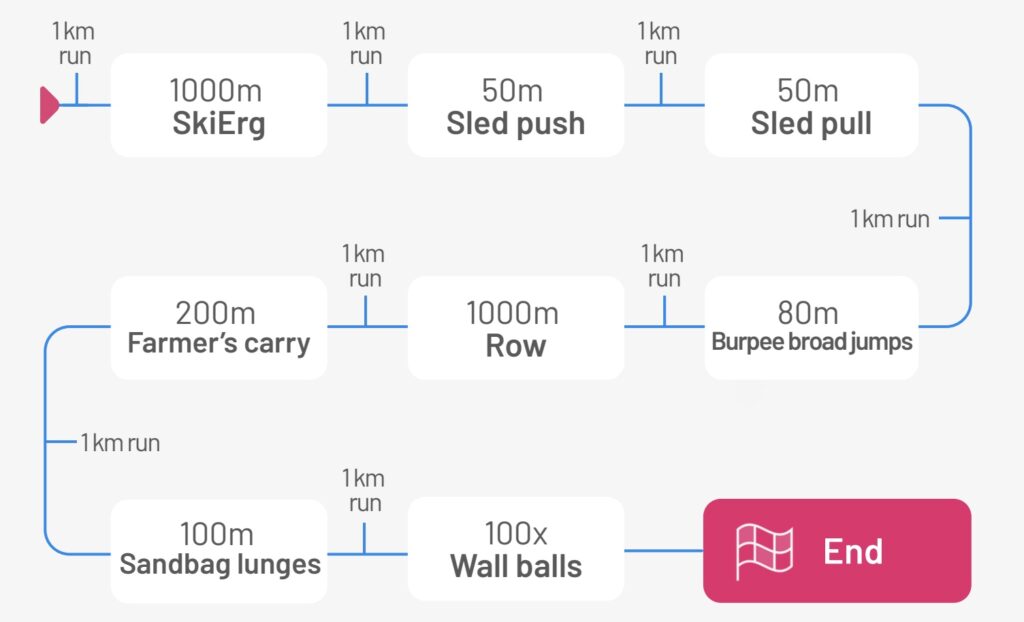
SugarWOD tip: Create “Race Simulation” workouts that follow this exact order. You can also find ready-to-go HYROX programs from coaches like PRVN in the SugarWOD Marketplace.
6. Do not underestimate the sled work

The sled push and pull define HYROX. They’re heavy, grueling, and vary by surface. On carpet, the sled can feel almost twice as heavy as on turf.
Race weights:
- Men: 152 kg push / 103 kg pull (sled + plates)
- Women: 103 kg push / 78 kg pull
Train smarter:
- Practice on similar flooring to race day
- Alternate between long steady pushes and short explosive drives
- Track your RPE (Rate of Perceived Exertion) after each session in SugarWOD
Over time, you’ll see how your sled work affects the rest of your performance.
7. Do wall balls ruin your finish?
Those final 100 wall balls for men or 75 for women hit when your body is already on the edge. If you rush or lose form, you’ll waste energy and time.
SugarWOD tip: Train wall balls when tired. End your metcons with wall ball sets to mimic race fatigue. Log your rep breaks in SugarWOD so you can find your ideal set strategy.
Pro data: Top HYROX athletes finish wall balls in under 4 minutes. Most others take over 6.
8. Train with community, race with confidence
Training alone builds discipline, but training with others builds resilience. HYROX rewards consistency, pacing, and mental toughness—qualities that grow stronger in a supportive community.
Whether it’s group runs, shared metcons, or team challenges, surrounding yourself with motivated athletes helps you push harder and stay accountable.
SugarWOD tip: Join or create a community track so you can compare scores, celebrate wins, and stay consistent together. When race day comes, that shared momentum becomes a competitive edge.

HYROX might be an individual race, but training alone can hold you back. Athletes who train in groups stick to their programs more consistently and improve faster.
Research says: Group training boosts adherence by 22 percent and overall performance by about 14 percent.
SugarWOD tip: Join your gym’s community board, post your results, and cheer on others. Seeing teammates log their workouts keeps motivation high and makes training more fun.
Race Smart, Finish Strong
HYROX success is about more than strength and endurance. It’s about pacing, planning, and staying mentally sharp. Avoiding these race-day mistakes helps you perform with confidence when it counts.
SugarWOD gives you the tools to do it: pacing logs, transition tracking, RPE monitoring, and easy access to proven HYROX programs.
Ready to train smarter and race stronger?
Check out HYROX-ready programs from PRVN and others in the SugarWOD Marketplace.
FAQs
Most athletes finish in 75 to 105 minutes, and elite athletes typically complete it in just over an hour.
Men push 152 kg and pull 103 kg, while women push 103 kg and pull 78 kg.
Aim for two running sessions, two HYROX-specific strength sessions, and one full race simulation every two to three weeks.
SugarWOD lets you log workouts, track pacing and progress, engage with your training group, and follow HYROX programs designed by top coaches.
A balanced pre-race meal with easily digested carbohydrates about three hours before the start helps maintain steady energy throughout the event.